

Flat Panel Antenna Market Size to Reach US$37.2 Billion by 2033, Growing at 12.4% CAGR
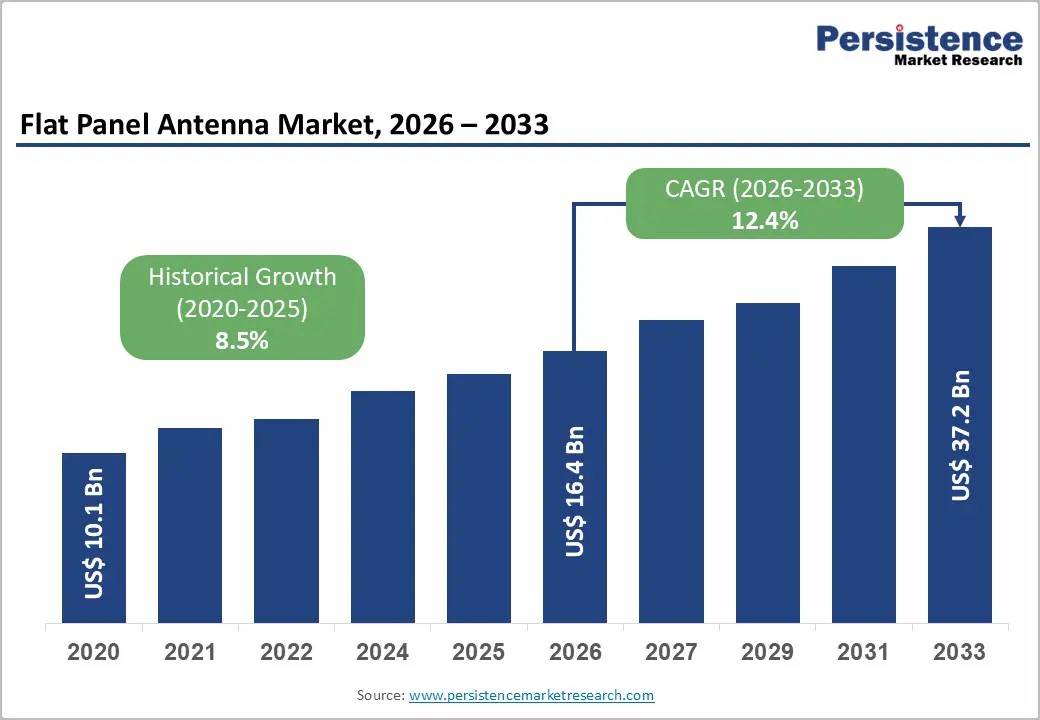
The global flat panel antenna market is valued at US$ 16.4 billion in 2026 and is projected to reach US$ 37.2 billion by 2033, growing at a CAGR of 12.4%
BRENTFORD, ENGLAND, UNITED KINGDOM, July 20, 2026 /EINPresswire.com/ -- The global flat panel antenna market is expected to reach US$16.4 billion in 2026 and grow to US$37.2 billion by 2033, expanding at a CAGR of 12.4%. Growth is driven by rising demand for satellite connectivity across commercial aviation, defense, maritime, enterprise broadband, and the rapid expansion of LEO satellite constellations such as Starlink, OneWeb, and Project Kuiper.
Electronically steered antennas are expected to dominate with a 67.0% share in 2026, supported by advanced beam steering, multi-orbit connectivity, and seamless satellite tracking capabilities. North America leads the market with a 36.0% share, driven by strong LEO operator presence, defense SATCOM modernization, and advanced satellite infrastructure. Increasing adoption of high-throughput satellites, multi-band communication systems, and regulatory support from the FCC and ITU are further accelerating market growth.
𝐆𝐞𝐭 𝐚 𝐒𝐚𝐦𝐩𝐥𝐞 𝐏𝐃𝐅 𝐁𝐫𝐨𝐜𝐡𝐮𝐫𝐞 𝐨𝐟 𝐭𝐡𝐞 𝐑𝐞𝐩𝐨𝐫𝐭: https://www.persistencemarketresearch.com/samples/33344
Flat Panel Antenna Market Segmentation Analysis
The flat panel antenna market is segmented by antenna type, frequency band, end-use industry, and region. Based on antenna type, electronically steered antennas dominate due to their ability to provide rapid beam steering, continuous satellite tracking, and reliable connectivity for mobile applications. These antennas are widely used in LEO satellite networks, aviation, defense, maritime, and enterprise connectivity due to their compact design, high reliability, and no-moving-parts architecture.
Mechanically steered antennas continue to find demand in cost-sensitive applications such as fixed broadband and selected maritime deployments. Their lower cost compared with electronically steered solutions supports adoption where advanced beam agility is not a primary requirement.
By frequency band, Ku Band leads the market with around 40.0% share in 2026, supported by mature GEO satellite infrastructure, VSAT networks, and widespread use in aviation, maritime, and enterprise communication. Ka Band is the fastest-growing segment, driven by high-throughput satellite services, LEO constellation deployment, and increasing demand for high-speed broadband connectivity.
Based on end-use industry, telecommunication is the largest segment with approximately 33.0% share in 2026, fueled by rising satellite broadband demand in rural, remote, maritime, and enterprise environments. The defense and government segment is also expanding rapidly due to increasing investments in secure SATCOM systems, tactical networks, UAV connectivity, and mobile military platforms.
Regional Insights into the Flat Panel Antenna Market
North America is expected to lead the flat panel antenna market with approximately 36.0% share in 2026, supported by strong satellite communication infrastructure, defense modernization programs, and the presence of major LEO operators such as SpaceX and Amazon. The U.S. market is driven by Starlink adoption, Project Kuiper development, military SATCOM investments, and rural broadband initiatives.
Europe represents a significant market with around 27.0% share in 2026, driven by increasing demand for aviation connectivity, maritime communication, defense modernization, and government satellite programs. Germany, the U.K., and France are key contributors due to their strong aerospace industries, industrial digitalization, and defense investments.
Asia Pacific is projected to be the fastest-growing region, expanding at a CAGR of 17.5% through 2033. Growth is supported by satellite connectivity programs, rural broadband expansion, maritime demand, and national space initiatives across China, India, and Japan. China’s LEO satellite investments, Japan’s defense modernization efforts, and India’s growing private space sector are creating significant opportunities for flat panel antenna manufacturers.
𝐃𝐨 𝐘𝐨𝐮 𝐇𝐚𝐯𝐞 𝐀𝐧𝐲 𝐐𝐮𝐞𝐫𝐲 𝐎𝐫 𝐒𝐩𝐞𝐜𝐢𝐟𝐢𝐜 𝐑𝐞𝐪𝐮𝐢𝐫𝐞𝐦𝐞𝐧𝐭? 𝐑𝐞𝐪𝐮𝐞𝐬𝐭 𝐂𝐮𝐬𝐭𝐨𝐦𝐢𝐳𝐚𝐭𝐢𝐨𝐧 𝐨𝐟 𝐑𝐞𝐩𝐨𝐫𝐭: https://www.persistencemarketresearch.com/request-customization/33344
Flat Panel Antenna Market Drivers
The rapid growth of LEO satellite constellations is driving demand for flat panel antennas, as these systems require advanced terminals capable of real-time satellite tracking and seamless beam switching. Rising defense modernization, tactical communication needs, and satellite-based broadband expansion in underserved regions are further accelerating adoption.
Flat Panel Antenna Market Restraints
High manufacturing costs, complex semiconductor requirements, and regulatory challenges are limiting widespread adoption of flat panel antennas. Certification processes, spectrum regulations, and limited availability of advanced manufacturing capabilities also create deployment barriers.
Flat Panel Antenna Market Opportunities
Growing demand for defense-grade conformal antennas and LEO-enabled broadband connectivity presents significant opportunities for market players. Advances in beamforming technology, cost reduction, and partnerships with satellite operators are expected to support future market expansion.
𝐁𝐮𝐲 𝐍𝐨𝐰 𝐭𝐡𝐞 𝐃𝐞𝐭𝐚𝐢𝐥𝐞𝐝 𝐑𝐞𝐩𝐨𝐫𝐭: https://www.persistencemarketresearch.com/checkout/33344
Company Insights: Key Players in the Flat Panel Antenna Market
• Kymeta Corporation
• ThinKom Solutions
• L3Harris Technologies
• Cobham SATCOM
• Viasat
• Intellian Technologies
• All.Space (Isotropic Systems)
• Hanwha Phasor
• Ball Aerospace
• Gilat Satellite Networks
• ST Engineering
• China Starwin
• ALCAN Systems
• C-COM Satellites
Conclusion
The global flat panel antenna market is set for strong growth, driven by expanding LEO satellite networks, defense modernization, and rising demand for reliable broadband connectivity across aviation, maritime, commercial, and enterprise sectors.
Despite challenges such as high manufacturing costs and regulatory complexities, advancements in phased arrays, semiconductor integration, and beamforming technologies are improving scalability. North America will maintain market leadership, while Asia Pacific is expected to witness the fastest growth, strengthening the role of flat panel antennas in next-generation satellite communications.
Related Reports:
Pooja Gawai
Persistence Market Research
+1 646-878-6329
email us here
Visit us on social media:
LinkedIn
Instagram
Facebook
YouTube
X
Legal Disclaimer:
EIN Presswire provides this news content "as is" without warranty of any kind. We do not accept any responsibility or liability for the accuracy, content, images, videos, licenses, completeness, legality, or reliability of the information contained in this article. If you have any complaints or copyright issues related to this article, kindly contact the author above.
