

[Latest] Aircraft Survivability Equipment Market to Grow Rapidly, Hitting US$ 9.68 Billion by 2034 at 7.30% CAGR, due to Protecting Combat Fleets Against Evolving Infrared and Electronic Threats in Contested Airspace, says ZMR
NEW YORK, USA, July 20, 2026 (GLOBE NEWSWIRE) -- Zion Market Research has published a new research report titled “Aircraft Survivability Equipment Market By Equipment (Threat Detection Systems, Infrared Countermeasures, Electronic Countermeasures, Laser Warning Systems, Integrated Suites, and Countermeasure Dispensers), By Fleet Type (Unmanned Aerial Vehicles (UAVs), Rotary Wings, and Fixed Wings), By Application (Defense and Commercial), and By Region - Global and Regional Industry Overview, Market Intelligence, Comprehensive Analysis, Historical Data, and Forecasts 2025 - 2034” in its research database.
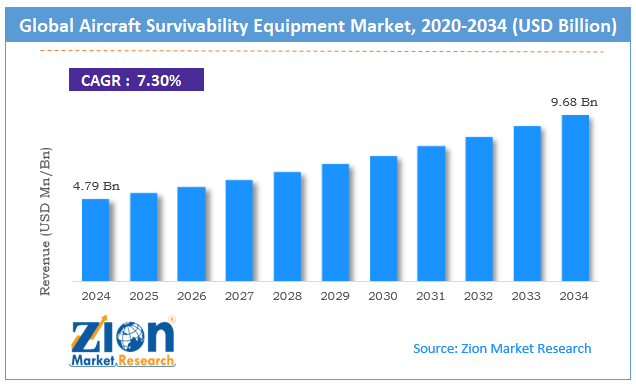
“According to the latest research study, the global aircraft survivability equipment market size was valued at around USD 4.79 billion in 2024. The market is expected to grow at a CAGR of 7.30% and is anticipated to reach a value of USD 9.68 billion by 2034.”
Get a Free Sample PDF of this Research Report for more Insights - https://www.zionmarketresearch.com/sample/aircraft-survivability-equipment-market
Aircraft Survivability Equipment Market Overview:
The aircraft survivability equipment market comprises a highly specialized segment within the aerospace and defense sector that focuses on the design, manufacturing, and integration of automated systems intended to optimize the operational baseline of an aircraft against hostile actions. These electronic defense arrays function contextually across multiple protection phases, identifying immediate indicators of threat engagement, deploying appropriate hard-kill or soft-kill passive and active countermeasures, and distorting an adversary's tracking and weapon guidance mechanisms. By integrating diverse tactical fields such as radar warning receivers, laser intercept solutions, signature suppressors, and directed energy jamming components, this industrial sector plays an essential role in preserving advanced airframes and securing tactical dominance during complex deployment scenarios.
The structural dynamics shaping this environment are dictated by a continuous technological evolutionary race between military platform defenses and intercept capabilities. Geopolitical realignments, asymmetric warfare deployments, and the widespread adoption of modern shoulder-launched man-portable air defense complexes have forced defense planners to elevate standard fleet survival systems from standard equipment options into fundamental architectural requirements. Concurrently, the operational environment is seeing substantial demand adjustments as military entities balance the procurement of advanced multi-role aerial platforms against the cost-efficient modification of current legacy fixed-wing and rotary configurations. This dynamic establishes a highly continuous marketplace where multi-year governmental programs, strict certification guidelines, and rapid micro-electronic innovations combine to influence long-term system deployment paths.
Report Scope:
| Report Attribute | Report Details |
| Market Size in 2024 | USD 4.79 Billion |
| Market Forecast in 2034 | USD 9.68 Billion |
| Growth Rate | CAGR of 7.30% |
| Base Year | 2024 |
| Forecast Years | 2025- 2034 |
| Key Companies Covered | BAE Systems plc, Elbit Systems Ltd., Survitec Group Limited, Thales Group, TULMAR Safety Systems, Ballistic Recovery Systems (BRS Aerospace), Northrop Grumman Corporation, RTX Corporation (Raytheon Technologies), Martin-Baker Aircraft Company Limited, Honeywell Aerospace, Safran S.A., FCAH Aerospace, RUAG Ltd., Saab AB, AmSafe Inc., and others. |
| Segments Covered | By Equipment, By Fleet Type, By Application, and By Region |
| Regions Covered | North America, Europe, Asia Pacific, Latin America, and the Middle East & Africa |
| Customization Scope | Avail customized purchase options to meet your exact research needs. |
Directly Purchase a Copy of the Report | Quick Delivery Available - https://www.zionmarketresearch.com/buynow/su/aircraft-survivability-equipment-market
Key Insights from Primary Research
- As per the analysis, the aircraft survivability equipment market share is likely to grow at a CAGR of around 7.30% between 2025 and 2034.
- The aircraft survivability equipment market size was worth around $4.79 billion in 2024 and is estimated to hit approximately $9.68 billion by 2034. Due to a variety of driving factors, the market is predicted to rise at a significant rate.
- The global aircraft survivability equipment market is driven by escalating defense modernizations globally, along with rising geometric threats from infrared-guided and radar-homing tracking weapons.
- Based on the equipment, the electronic countermeasures segment dominated the market with a significant share of approximately 38.0% in 2024 because they serve as the crucial foundational layer of platform security, effectively neutralizing complex radar indicators and enemy jamming applications.
- Based on the fleet type, fixed wings emerged as the leading segment, holding over 46.5% of the market share in 2024 due to extensive multi-role utilization of fighter, cargo, and maritime patrol aircraft across active military frameworks.
- Based on the application, defense represents the dominant segment with more than 85.0% market share in 2024 because the operational requirement for advanced weapon tracking avoidance, missile detection arrays, and counter-threat integration remains intrinsically tied to state-sponsored defense spending and combat readiness.
- Based on the regional segment, North America stands as the most dominant market, capturing over 44.0% of global revenues in 2024 owing to its massive defense expenditure, early integration of fifth-generation stealth assets, and presence of pioneering system manufacturing entities.
Aircraft Survivability Equipment Market: Dynamics
Growth Drivers
How is the escalation of regional conflicts accelerating global procurement framework requirements?
The rapid proliferation of localized disputes and geopolitical border tensions across various international theaters is profoundly forcing global defense infrastructure to prioritize tactical aviation resilience. Modern battlefield environments feature highly dangerous air defense networks where multi-layered weapon arrays present continuous hazards to low-flying and high-altitude logistics platforms alike. Consequently, multiple defense organizations are allocating significant capital resources specifically toward strengthening localized fleet dynamics, directly prioritizing integrated electronic suites over simple mechanical adjustments.
Furthermore, the persistent development of modern asymmetric warfare practices by non-state actors has rendered conventional non-combat transport configurations highly vulnerable during routine troop and supply insertion profiles. The integration of specialized warning receivers and laser countermeasures ensures that aircrews can actively track incoming infrared trajectories and react within tight tactical timelines. This widespread requirement for enhanced protection during humanitarian, tactical transport, and reconnaissance sorties creates a solid framework for sustained commercial growth across the primary defense supply chain.
Restraints
What complications do high initial implementation expenditures and severe export limitations create for widespread market integration?
The production of modern aircraft survivability systems demands immense long-term capital resources dedicated to custom hardware fabrication, advanced signal processing algorithm formulation, and complex aerodynamic flight validation phases. These extensive financial demands create an entry barrier that effectively prices out minor regional defense clients or nations operating under constrained state capital conditions. As a direct result, manufacturers must navigate narrow, highly concentrated procurement frameworks, which heighten operational exposure to sudden programmatic cancellations or shifted governmental defense priorities.
Additionally, due to the critical nature of advanced electronic jamming technologies, digital warfare applications, and localized laser arrays, these products remain subject to exceptionally restrictive international security regulations such as the International Traffic in Arms Regulations. These rigid national oversight mandates limit the direct export potential of top-tier defensive products to trusted defense coalitions and close geopolitical allies. The resulting narrow addressable market limits mass manufacturing opportunities, extending return timelines on internal research investments and slowing international volume expansion.
Opportunities
How does the expansion of high-end unmanned aerial systems open new fields for lightweight defense architectures?
The widespread adoption of Unmanned Aerial Vehicles for high-stakes intelligence gathering, deep-strike logistics, and persistent combat support provides an expansive arena for system component integration. Historical deployments have validated that standard attritable uncrewed units suffer severe operational losses when exposed to modern electronic warfare environments and active missile defenses. To protect these increasingly expensive remote platforms, defense entities are shifting focus toward equipping high-altitude, long-endurance assets with miniature warning modules and optimized countermeasure configurations.
This growing segment creates specialized avenues for system designers to develop highly lightweight, ultra-compact, and low-power survivability suites tailored specifically to unmanned structures. By omitting the physical mass requirements of human life-support arrays, engineers can focus on hyper-dense multi-spectral sensors and software-driven digital countermeasure architectures. As autonomous combat aviation integration expands within standard military doctrines, the demand for adaptable, lightweight protection modules is anticipated to undergo parallel structural growth.
Challenges
How do rapid improvements in machine-learning threat algorithms outpace static defensive processing architectures?
The continuous technological race between missile guidance processing speeds and airborne defense evasion techniques presents a critical operational hurdle for long-term platform protection. Modern anti-aircraft weapons utilize advanced multi-spectral seekers and localized artificial intelligence to effortlessly isolate actual aircraft silhouettes from deployed decoy flares or simulated radar chaff curtains. Because these adversarial tracking adaptations evolve at digital speeds, standard fixed-architecture physical hardware installations face rapid functional obsolescence on the modern battlefield.
To combat this, system developers must completely restructure modern aircraft suites around flexible, software-defined software frameworks that support rapid over-the-air database updates and cognitive algorithms. However, upgrading field-deployed fleets with advanced digital processing hardware introduces major complications regarding structural weight balances, thermal dissipation management, and existing onboard electrical constraints. Resolving these complex electrical and thermal engineering issues while maintaining real-time sub-millisecond automated protection cycles represents a continuous challenge for global development teams.
Browse the full “Aircraft Survivability Equipment Market By Equipment (Threat Detection Systems, Infrared Countermeasures, Electronic Countermeasures, Laser Warning Systems, Integrated Suites, and Countermeasure Dispensers), By Fleet Type (Unmanned Aerial Vehicles (UAVs), Rotary Wings, and Fixed Wings), By Application (Defense and Commercial), and By Region - Global and Regional Industry Overview, Market Intelligence, Comprehensive Analysis, Historical Data, and Forecasts 2025 - 2034” Report at https://www.zionmarketresearch.com/report/aircraft-survivability-equipment-market
Aircraft Survivability Equipment Market: Segmentation
The aircraft survivability equipment market is segmented by equipment, fleet type, application, and region.
Based on the Equipment Segment, the aircraft survivability equipment market is divided into threat detection systems, infrared countermeasures, electronic countermeasures, laser warning systems, integrated suites, and countermeasure dispensers. Within this breakdown, electronic countermeasures stand as the most dominant segment, driven heavily by their indispensable architectural contribution to modern electronic spectrum dominance and comprehensive radar tracking disruption. The second most dominant segment is threat detection systems, which provide the critical foundation for all defensive activities by ensuring early warning identification of multi-spectral laser, radar, and infrared missile signatures. Both segments work systematically to enhance overall platform durability, ensuring that subsequent countermeasure systems possess the necessary localized data to intercept threats efficiently.
Based on Fleet Type Segment, the aircraft survivability equipment market is divided into unmanned aerial vehicles (UAVs), rotary wings, and fixed wings. The fixed-wing segment commands the most dominant position due to massive global procurement projects focused on high-value fifth-generation fighters, military transport units, and regional intelligence collection airframes. The second most dominant position is held by rotary wings, which require sophisticated protection architectures due to their constant low-altitude operations, exposure to urban combat environments, and vulnerability to ground-launched shoulder missiles. The steady introduction of these suites onto combat and transport helicopters directly accelerates the overarching commercial market revenue stream.
Based on Application Segment, the aircraft survivability equipment market is divided into defense and commercial. The defense acts as the primary dominant segment within this category, capturing the vast majority of international market share due to its direct exposure to active combat, international safety mandates, and heavy government funding support. The second most dominant segment is the Commercial sector, which utilizes selective survivability architectures primarily on high-profile executive transport aircraft, heads-of-state fleets, and specialized logistics lines operating over high-risk geographical sectors. The rigorous safety requirements inherent to government defense deployment structures ensure that the military sector remains the foundational pillar of market growth.
Regional Scope:
Why will North America continue to dominate the global market during the projection period?
North America maintains a highly dominant presence in the global aircraft survivability equipment marketplace and is projected to preserve this leadership position throughout the forecast period. The primary factor underlying this regional dominance is the massive defense budget of the United States, which continuously emphasizes technological superiority and comprehensive platform safety across all combat commands. The region benefits from early deployment schedules of next-generation aviation systems like the B-21 Raider and Next Generation Air Dominance frameworks, both requiring specialized internal defense components.
Furthermore, the regional landscape is strongly supported by an established, high-density aerospace industry containing leading global defense technology integrators and subsystem innovators. This concentration of technical expertise allows for rapid design validation, localized supply chain stability, and seamless implementation of software-defined warfare tools across multiple airframes. The focus on establishing absolute electromagnetic spectrum superiority within active deployment doctrines guarantees that regional investments in advanced threat detection and warning tools will outpace other geographic markets.
Asia-Pacific represents the fastest-growing regional market, propelled by accelerating defense expenditure across nations like India, China, Japan, and South Korea as they seek to upgrade domestic air power. Geopolitical tensions across the South China Sea and regional borders are forcing these nations to transition away from legacy aircraft architectures toward advanced, survivability-equipped platforms. Increased spending on domestic development programs and collaborative international defense acquisitions across the region creates a strong environment for long-term installation and retrofit components.
Recent Developments
- In June 2024, BAE Systems plc completed a comprehensive integration framework for its next-generation digital radar warning receiver architecture, designed to provide ultra-wideband situational awareness across heavily contested electromagnetic airspace environments.
- In September 2024, Northrop Grumman Corporation secured a major multi-year modification contract from the United States military to expand production and implementation of its highly advanced Common Infrared Countermeasure systems across diverse rotary-wing fleets.
- In February 2025, Elbit Systems Ltd demonstrated an upgraded configuration of its MUSIC Directed Infrared Countermeasure suite, incorporating advanced artificial intelligence tracking filters to significantly decrease reaction times against modern man-portable tracking weaponry.
Request For Customization on This Report as Per Your Requirements - https://www.zionmarketresearch.com/custom/9499
Aircraft Survivability Equipment Market: Competitive Landscape
The report contains qualitative and quantitative research on the global aircraft survivability equipment market, as well as detailed insights and development strategies employed by the leading competitors.
Some of the main players in the global aircraft survivability equipment market include;
- BAE Systems plc
- Elbit Systems Ltd.
- Survitec Group Limited
- Thales Group
- TULMAR Safety Systems
- Ballistic Recovery Systems (BRS Aerospace)
- Northrop Grumman Corporation
- RTX Corporation (Raytheon Technologies)
- Martin-Baker Aircraft Company Limited
- Honeywell Aerospace
- Safran S.A.
- FCAH Aerospace
- RUAG Ltd.
- Saab AB
- AmSafe Inc.
Key Trends in the Aircraft Survivability Equipment Market
Migration toward cognitive electronic warfare and AI-driven automated response filtering mechanisms
A major transformation occurring within the industry involves transitioning away from pre-programmed, library-reliant threat detection software toward cognitive processing architectures powered by deep-learning models. Modern threat environments exhibit complex radar agile wave patterns that can bypass traditional warning systems by constantly altering baseline frequencies. By incorporating real-time machine learning directly into processing modules, current generation survivability equipment can seamlessly analyze unidentified radar or infrared inputs, estimate threat parameters instantly, and formulate customized jammer configurations on the fly.
Transition to modular open systems architecture and generalized line-replaceable configurations
Another significant operational trend is the widespread integration of Modular Open Systems Architecture guidelines across multi-role aircraft upgrade initiatives. Historically, implementing a new laser warning receiver or upgraded countermeasure dispenser meant completely modifying an airframe's internal operational software, generating massive engineering costs and lengthy fleet grounding cycles. Adopting open system standard interfaces allows defense operators to swap out aging line modules and integrate updated sensor units with minimal custom programming, drastically lowering lifecycle sustainment costs.
The global aircraft survivability equipment market is segmented as follows:
By Equipment
- Threat Detection Systems
- Infrared Countermeasures
- Electronic Countermeasures
- Laser Warning Systems
- Integrated Suites
- Countermeasure Dispensers
By Fleet Type
- Unmanned Aerial Vehicles (UAVs)
- Rotary Wings
- Fixed Wings
By Application
- Defense
- Commercial
By Region
- North America
- The U.S.
- Canada
- Europe
- France
- The UK
- Spain
- Germany
- Italy
- Rest of Europe
- Asia Pacific
- China
- Japan
- India
- Southeast Asia
- Rest of Southeast Asia
- The Middle East & Africa
- GCC
- South Africa
- Rest of the Middle East & Africa
- Latin America
- Brazil
- Argentina
- Rest of Latin America
Request Free Brochure of the Global Aircraft Survivability Equipment Market @ https://www.zionmarketresearch.com/requestbrochure/aircraft-survivability-equipment-market
Key Questions Answered in This Report:
- What is aircraft survivability equipment?
- Which key factors will influence the aircraft survivability equipment market growth over 2025-2034?
- What will be the value of the aircraft survivability equipment market during 2025-2034?
- What will be the CAGR value of the aircraft survivability equipment market during 2025-2034?
- Which region will contribute notably towards the aircraft survivability equipment market value?
- Which are the major players leveraging the aircraft survivability equipment market growth?
- What can be expected from the global aircraft survivability equipment market report?
Browse Other Related Research Reports from Zion Market Research
- Airport Metal Detectors Market By Product Type (Walk-Through Metal Detectors, Handheld Metal Detectors, and Ground Search Metal Detectors), By Application (Passenger Screening, Baggage and Parcel Inspection, Staff and Crew Screening, and Perimeter Security), By End-User (International Airports, Domestic Airports, Private & Charter Airports, and Military & Government Terminals), By Distribution Channel (Direct Government Procurement, System Integrators and Contractors, Security Equipment Distributors, and Online Procurement Platforms), and By Region - Global and Regional Industry Overview, Market Intelligence, Comprehensive Analysis, Historical Data, and Forecasts 2025 - 2034
- Military Unmanned Underwater Vehicles (UUV) Market By UUV Type (Hybrid Underwater Vehicles (HUV), Autonomous Underwater Vehicles (AUV), and Remotely Operated Vehicles (ROV)), By Sub-System (Communication & Navigation, Payloads & Imaging, Collision Avoidance, Drive System, and Propulsion), By Operational Range (Shallow Vehicles, Medium Vehicles, and Large Vehicles), By Application (Naval & Coastal Defense, Oil & Gas, Oceanography, Search & Salvage Operations, Environmental & Meteorological Research, and Others), and By Region - Global and Regional Industry Overview, Market Intelligence, Comprehensive Analysis, Historical Data, and Forecasts 2025 - 2034
- Ship And Boat Building And Maintenance Market By Type (Ship & Boat Construction, Ship & Boat Maintenance, Ship & Boat Conversion and Alteration, Prefabricated Ship and Specialized Services), By Application (Private Use, Commercial Use and Military Use) and By Region - Global and Regional Industry Overview, Market Intelligence, Comprehensive Analysis, Historical Data, and Forecasts 2025 - 2034
- Aircraft Engine MRO Market By Engine Type (Turbofan, Turboprop, Turboshaft, Piston Engine), By Aircraft Type (Commercial Aircraft, Military Aircraft, Business Jets, Helicopters, General Aviation), By Service Type (Engine Overhaul, Engine Replacement, Component Repair, Performance Restoration), By End-User (Airlines, MRO Service Providers, Military and Defense, Independent Operators), By Maintenance Type (Line Maintenance, Base Maintenance, Heavy Maintenance), and By Region - Global and Regional Industry Overview, Market Intelligence, Comprehensive Analysis, Historical Data, and Forecasts 2025 - 2034
- Aerospace Plastic Market By Plastic Type (Polyetheretherketone, Polycarbonate, Polymethyl Methacrylate, Polyamide, Polyphenylene Sulfide, and Others), By Application (Interior Components, Exterior Components, Propulsion Systems, Electrical Systems, Windows and Transparencies, Structural Parts), By Aircraft Type (Commercial Aviation, Military Aviation, General Aviation, Helicopters, Space Vehicles), By Manufacturing Process (Injection Molding, Thermoforming, Compression Molding, Additive Manufacturing, Extrusion), By End-User (OEM Production, Aftermarket Replacement, Maintenance and Repair Services), and By Region - Global and Regional Industry Overview, Market Intelligence, Comprehensive Analysis, Historical Data, and Forecasts 2025 - 2034
About Zion Market Research:
Zion Market Research is a leading market research organization offering industry expertise and scrupulous consulting services to clients for their business development. The reports and services offered by Zion Market Research are used by prestigious academic institutions, start-ups, and companies globally to measure and understand the changing international and regional business backgrounds.
Contact Us:
Zion Market Research
USA/Canada Toll Free: 1 (855) 465-4651 | Newark: 1 (302) 444-0166
India: +91 7768 006 007 | +91 7768 006 008
Email: sales@zionmarketresearch.com | Web: https://www.zionmarketresearch.com/
Follow Us on - LinkedIn | X | Facebook | Pinterest | YouTube


Legal Disclaimer:
EIN Presswire provides this news content "as is" without warranty of any kind. We do not accept any responsibility or liability for the accuracy, content, images, videos, licenses, completeness, legality, or reliability of the information contained in this article. If you have any complaints or copyright issues related to this article, kindly contact the author above.
